The start of a new tax year is a useful moment to review your wider financial position.
For many people, tax planning is something they think about near the end of the tax year, usually when time is limited and decisions feel rushed. A more effective approach is to review your allowances, pensions, savings and investments earlier, so that decisions can be made with more care.
Tax year planning is not just about reducing tax. It is about making sure your money is structured properly, your allowances are being used where appropriate, and your financial arrangements still support your long-term goals.
For clients with pensions, ISAs, investments, business interests, property, inheritance tax concerns or retirement plans, small annual decisions can make a meaningful difference over time.

Why tax year planning matters
Tax allowances are often described as “use it or lose it” because many of them cannot be carried forward if unused.
That does not mean every allowance should automatically be used by every person. Suitability matters. What is right for one client may be inappropriate for another.
However, reviewing your position early can help you avoid missed opportunities, unnecessary tax exposure or poor decisions made under time pressure.
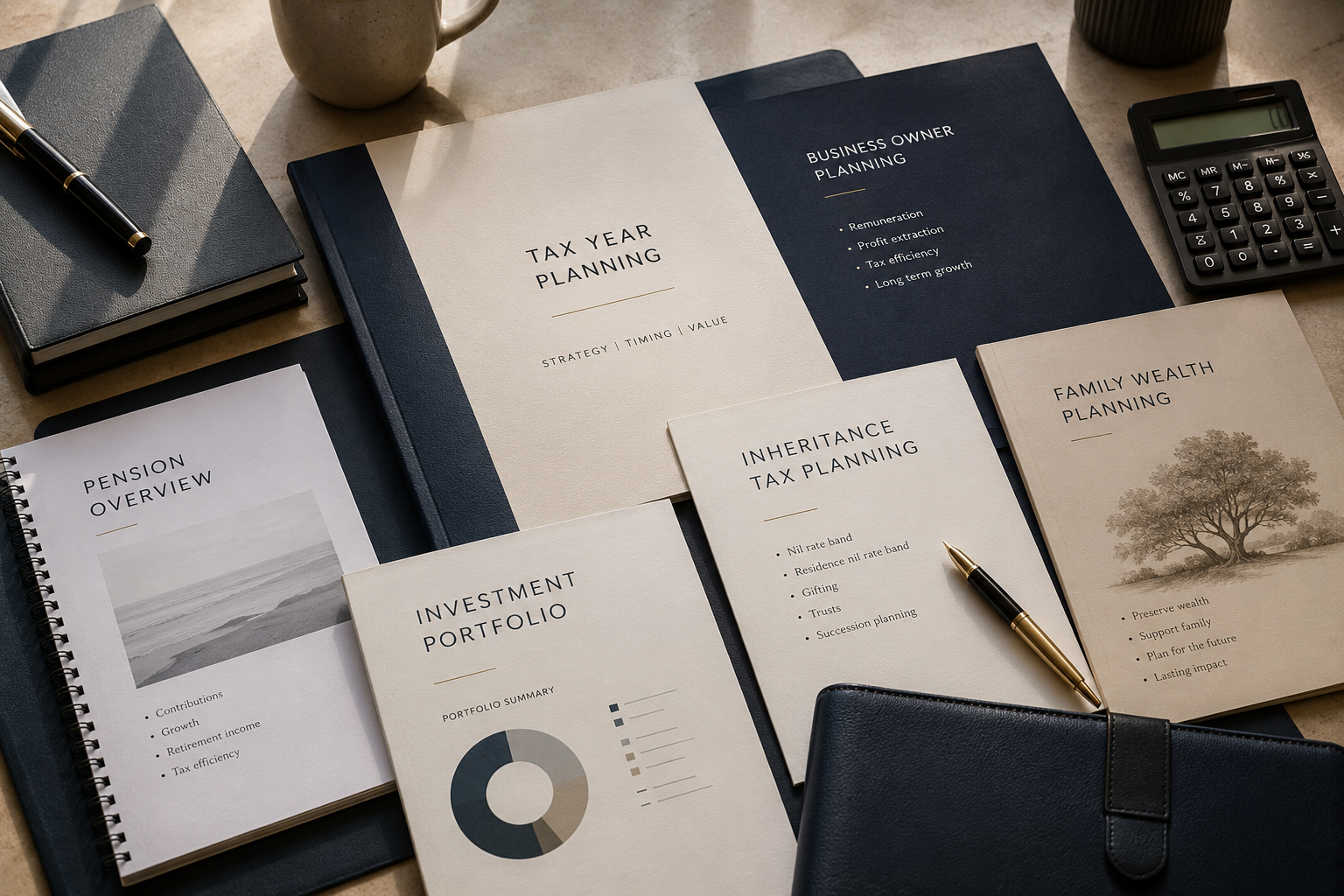
A tax year planning review may include:
- ISA contributions
- Pension contributions
- Capital gains tax planning
- Dividend and savings income
- Use of available allowances
- Business owner and director planning
- Retirement income planning
- Inheritance tax considerations
- Investment structure and tax efficiency
The aim is to look at the whole picture rather than treating each allowance in isolation. For many clients, that means bringing tax planning together with wider investment advice, pension planning and long-term family wealth planning.
ISA planning for 2026/27
ISAs remain one of the most widely used tax-efficient savings and investment wrappers.
For the 2026/27 tax year, the annual ISA allowance remains an important planning point. ISAs can be useful because income and gains within the wrapper are generally free from UK income tax and capital gains tax.
A Cash ISA may be suitable for short-term savings, emergency funds or money that should not be exposed to investment risk. A Stocks and Shares ISA may be more appropriate for longer-term investment planning, where the investor is comfortable accepting market risk in pursuit of growth.
The right balance between cash and investments depends on your circumstances, objectives, time horizon and attitude to risk.
Questions to consider include:
- Are you making full use of your ISA allowance where appropriate?
- Is too much long-term money sitting in cash?
- Are your existing ISAs invested in line with your current objectives?
- Are you holding old ISAs that have not been reviewed for several years?
- Are ISAs being used alongside pensions and other investments effectively?
An ISA is a wrapper, not a financial plan in itself. What matters is how it fits into your wider strategy.
Tax planning should support the financial plan. It should not become the financial plan.
Pension planning
Pensions remain one of the most important areas of tax year planning, particularly for clients approaching retirement, higher earners, business owners and company directors.
Pension contributions can offer valuable tax relief, but they should be planned carefully. The level of contribution that is appropriate will depend on earnings, existing pension provision, annual allowance rules, retirement objectives and wider cash flow needs.
For business owners and directors, pension planning may also interact with company profit extraction, corporation tax planning and long-term retirement strategy.
A pension review may consider:
- Whether current contributions remain appropriate
- Whether unused allowances from previous years may be available
- Whether the annual allowance or tapered annual allowance is relevant
- How pension contributions fit alongside salary, dividends and business planning
- Whether old pensions should be reviewed or consolidated
- How pension funds may eventually support retirement income
Pension planning should not be approached simply as a tax exercise. It should be linked to the bigger question of what you want your retirement to look like and how your assets can support it. That is why tax year decisions should sit alongside proper pension and retirement planning, especially where clients are also considering pension drawdown advice, phased withdrawals or flexible retirement income.
Capital gains tax planning
Capital gains tax planning is another important consideration for clients with investment portfolios, second properties, business assets or other chargeable assets.
The annual exempt amount has reduced significantly in recent years, which means more people may find themselves within the capital gains tax system.
This does not mean assets should be sold just to use an allowance. However, where gains exist, it may be worth reviewing whether disposals, transfers, portfolio rebalancing or use of tax-efficient wrappers could improve the overall position.
Capital gains tax planning may involve:
- Reviewing unrealised gains
- Considering whether gains should be realised over more than one tax year
- Using available exemptions where appropriate
- Reviewing ownership between spouses or civil partners
- Considering the interaction with income tax bands
- Rebalancing portfolios in a tax-aware way
Tax should not drive the investment decision on its own. The investment must still be suitable.
Dividend and savings income
The tax position on dividends and savings income should also be reviewed, particularly for investors, directors and clients holding money outside ISAs and pensions.
For company directors, dividend tax planning may form part of a wider conversation about salary, dividends, pension contributions and business profit extraction.
For savers, higher interest rates can mean cash deposits create more taxable income than expected. This can be particularly relevant where larger sums are held outside tax-efficient wrappers.
A review may look at:
- Whether cash savings are held in the right place
- Whether ISA allowances are being used appropriately
- Whether investment income is tax-efficient
- Whether dividend income affects wider tax planning
- Whether pensions or other wrappers could improve the structure
Again, the goal is not to chase tax efficiency at all costs. The goal is to make sure the structure supports the client’s needs.
Business owner and director planning
For business owners and directors, tax year planning can be especially valuable because personal and company finances often overlap.
Planning may include:
- Director pension contributions
- Salary and dividend structure
- Retained profits
- Business protection
- Exit or succession planning
- Inheritance tax considerations
- Investment of surplus company funds
- Personal retirement planning
A business owner’s financial plan should not be separated from the business. The company may be a source of income, capital, risk and opportunity.
That is why business owner and director planning should usually be considered alongside retirement planning, investment planning and long-term family wealth planning.
Inheritance tax and family wealth
Tax year planning can also be a useful time to review inheritance tax and estate planning.
This may include looking at gifting, trusts, pensions, life cover, wills and the overall structure of family wealth.
Inheritance tax planning should be handled carefully. Decisions made purely for tax reasons can create problems if they affect control, access to capital, family dynamics or long-term financial security.
Useful questions include:
- Are your wills up to date?
- Are pension nominations current?
- Is life cover still appropriate?
- Have gifts been made or recorded properly?
- Is inheritance tax likely to be an issue?
- Would family wealth benefit from a clearer long-term plan?
The earlier inheritance tax planning is considered, the more options may be available.
Why planning early helps
Leaving tax planning until March can create unnecessary pressure.
By reviewing earlier in the tax year, you have more time to consider the right approach. This is particularly important where decisions involve investments, pensions, business structures or family wealth.
Early planning can help you:
- Avoid rushed decisions
- Use allowances more deliberately
- Plan pension contributions around cash flow
- Review investment gains before tax year end
- Coordinate personal and business planning
- Improve long-term financial structure
Tax planning is rarely about one isolated decision. It is usually about bringing several moving parts together.
The EWS view
At Executive Wealth Services, we believe tax year planning should form part of a wider financial planning conversation.
The question is not simply:
“How much tax can I save this year?” A better question is: “How should my pensions, investments, savings, business interests and family wealth be structured to support my long-term objectives?”
That approach allows tax planning to sit in the right place. It becomes part of the strategy, not the whole strategy.
For some clients, the immediate priority may be ISA or pension contributions. For others, it may be reviewing old investments, planning retirement income, assessing inheritance tax exposure or structuring business wealth more effectively.
The right approach depends on the individual. Clients who want joined-up support may benefit from speaking to a financial adviser in Edinburgh who can consider pensions, investments, tax planning and family wealth together.
Speak to EWS about tax year planning
Executive Wealth Services provides independent financial planning, pension advice and investment advice in Edinburgh, Glasgow and across Scotland.
If you would like to review your tax year planning, pension contributions, ISAs, investments or wider financial structure, EWS can help you look at the full picture.
Review your tax year planning with EWS
If your pensions, ISAs, investments or business finances have not been reviewed for some time, a structured conversation can help clarify whether your current arrangements still support your long-term objectives.
Tax treatment depends on individual circumstances and may be subject to change. This article is for general information only and does not constitute personal financial advice.